Insights
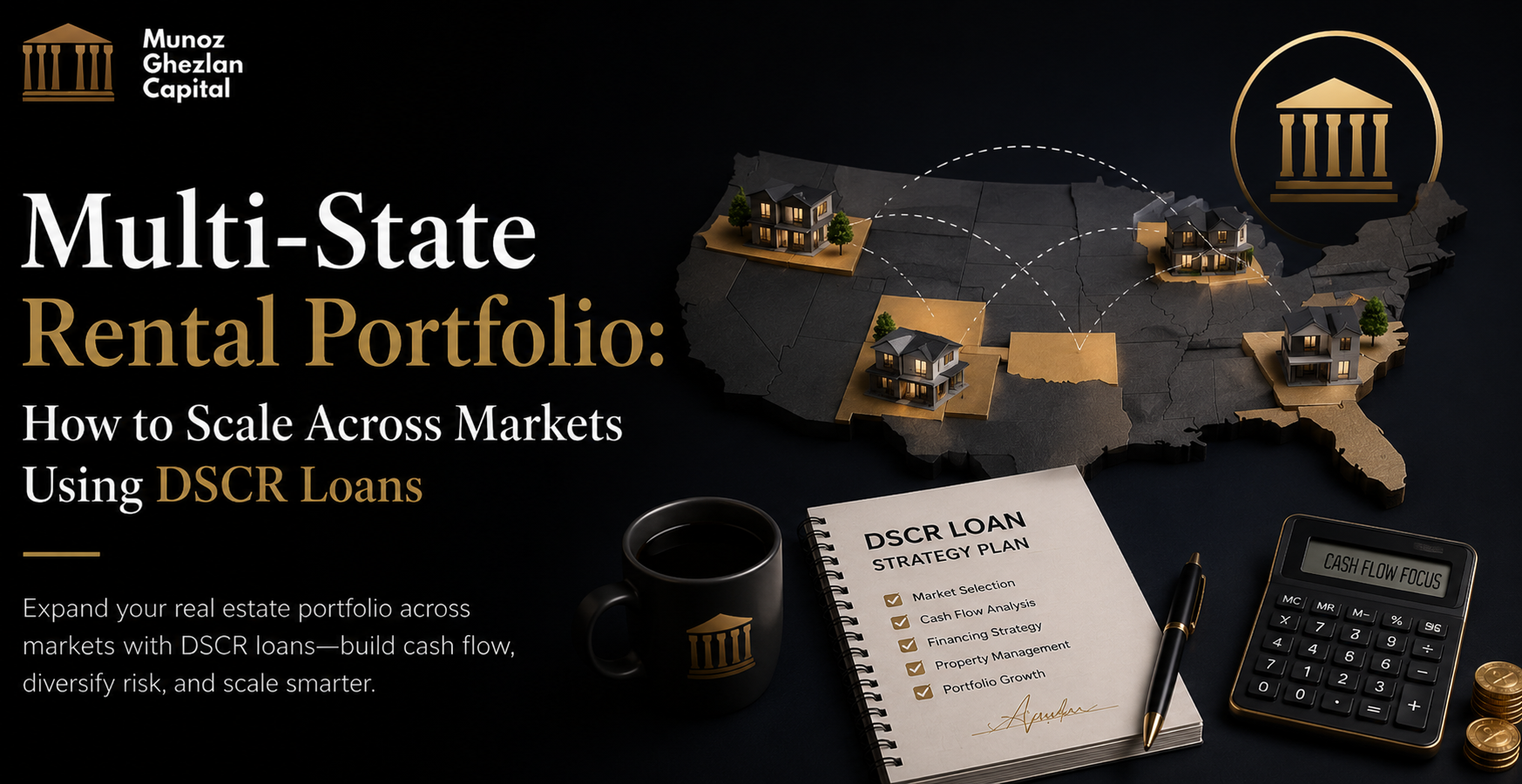
Multi-State Rental Portfolio: How to Scale Across Markets Using DSCR Loans

Multi-State Rental Portfolio: How to Scale Across Markets Using DSCR Loans

Learn how investors scale rental portfolios across states using DSCR loans, remote management systems, and cash-flow market strategies.

Published On  
May 24, 2026
Written By  
David Wilson
Contents

Discover What we can do for you

Talk to an Expert

Subscribe To Our Newsletter

Discover What we can do for you
Thank you! Your submission has been received!
Oops! Something went wrong while submitting the form.
 
class SampleComponent extends React.Component { 
  // using the experimental public class field syntax below. We can also attach  
  // the contextType to the current class 
  static contextType = ColorContext; 
  render() { 
    return <Button color={this.color} /> 
  } 
} 

David Wilson

David Wilson is a talented writer and poet whose work often reflects his deep appreciation for nature and the arts. He has published several collections of poetry and is known for his thought-provoking essays that challenge societal norms.

Subscribe To Our Newsletter

Discover What we can do for you
Thank you! Your submission has been received!
Oops! Something went wrong while submitting the form.

Building a rental portfolio used to mean staying close to home. Investors purchased one or two properties in their local market, managed tenants themselves, and slowly expanded over time. That strategy still works, but the modern investing landscape has changed. Rising home prices in many major metropolitan areas have prompted investors to seek stronger cash-flow opportunities beyond their own state lines. Markets across the Southeast and Midwest now attract investors looking for better rent-to-price ratios, landlord-friendly laws, and scalable portfolio growth.

That shift has made the idea of a multi-state rental portfolio DSCR strategy far more practical than it was a decade ago. DSCR loans enable investors to qualify primarily based on property income rather than personal debt-to-income ratios, making expansion across multiple markets easier. Investors no longer need to rely on a single local market to grow. With the right systems, financing structure, and market selection process, scaling across state lines becomes a repeatable strategy instead of a complicated guessing game.

Key Takeaways

  • A multi-state rental portfolio DSCR strategy helps investors scale beyond expensive local markets into stronger cash-flow regions.
  • DSCR loans focus on rental income instead of personal debt-to-income ratios, making portfolio expansion easier.
  • Midwest and Southeast markets continue attracting investors due to affordable pricing and stronger rent-to-price ratios.
  • Geographic diversification reduces reliance on a single local economy or housing market cycle.
  • Strong property management systems are essential for successful remote investing across multiple states.
  • Investors using out-of-state rental financing should prioritize landlord-friendly states, stable job growth, and consistent rental demand.
  • Cash reserves become increasingly important as portfolios grow across several markets.
  • Local teams, including property managers and contractors, directly impact long-term portfolio performance.
  • Scaling too quickly into multiple markets often creates operational problems and management inefficiencies.
  • Investors building portfolios through DSCR across state lines benefit most from repeatable acquisition systems and disciplined market selection.

Why Investors Are Expanding Beyond Their Local Markets

Many investors reach a ceiling after purchasing one or two rentals in their own city. Local prices rise faster than rents, cash flow shrinks, and finding strong deals becomes harder. Investors begin looking at other regions where numbers still make sense.

The Midwest and Southeast continue attracting attention because many cities still offer affordable purchase prices combined with stable rental demand. Markets such as Cleveland, Indianapolis, Birmingham, Memphis, and Kansas City often produce stronger monthly cash flow compared to expensive coastal cities where property appreciation dominates the investment thesis.

This creates a major advantage for investors focused on portfolio growth. One property with moderate cash flow may help cover its own expenses. Multiple cash-flowing rentals across several states create enough income to support long-term scaling.

The rise of remote investing technology has also changed how investors operate. Property management software, virtual showings, online rent collection, and remote inspections allow landlords to manage rentals without living nearby. Investors no longer need to stay geographically limited to build wealth through real estate.

At the same time, lenders have become more comfortable with investors buying properties in different states. That trend has made investing in multiple states with DSCR financing much more accessible for small and mid-sized investors.

How DSCR Loans Make Multi-State Expansion Easier

Traditional mortgage financing becomes difficult once investors start accumulating properties. Conventional loans focus heavily on personal income, tax returns, employment history, and debt-to-income ratios. As more properties are added, qualifying grows more complicated.

DSCR loans work differently.

Instead of focusing primarily on personal income, lenders evaluate the rental income generated by the property itself. The property’s debt service coverage ratio determines whether the expected rent comfortably covers the mortgage payment and operating expenses.

DSCR = Gross Rental Income ÷ Principal+Interest+Taxes+Insurance+HOA

This approach creates several advantages for investors building a cross-state portfolio.

A growing investor may already have multiple mortgages reporting on their credit profile. Conventional lenders often view that as a limitation. DSCR lenders focus more on property performance, making it easier to continue acquiring rentals even after several financed properties.

Another major advantage involves entity ownership. Many DSCR lenders allow purchases through LLCs, which helps investors structure multi-state portfolios more professionally. Investors commonly separate properties by state or by risk exposure, creating cleaner operational systems as portfolios grow.

The flexibility of out-of-state rental financing through DSCR programs has become one of the primary reasons investors scale nationally rather than staying tied to a single local market.

Choosing the Right Markets for a Multi-State Portfolio

Not every affordable market makes a good investment market. Investors scaling across state lines need a framework for selecting cities that support long-term portfolio growth.

Strong rental demand matters more than low purchase prices alone. Cheap properties located in shrinking cities often create management headaches, unstable tenant pools, and costly turnover.

The most successful investors look for markets with:

  • stable population trends
  • job growth
  • landlord-friendly regulations
  • diversified local economies
  • reasonable property taxes
  • strong rent demand

Midwest markets often attract cash-flow-focused investors because purchase prices remain relatively affordable compared to rents. Southeast markets attract investors seeking both appreciation potential and population growth.

A balanced multi-state strategy may include both types of markets. One state may deliver a stronger monthly cash flow while another contributes long-term appreciation and rent growth.

For example, an investor could own:

  • cash-flow rentals in Ohio
  • appreciation-focused properties in North Carolina
  • short-term rentals in Tennessee

This diversification reduces dependence on a single economy or housing cycle.

The structure of a multi-state rental portfolio DSCR strategy works best when every market serves a specific purpose within the larger portfolio.

The Operational Side of Scaling Across States

Financing helps investors acquire properties, but operations determine whether a portfolio remains profitable over time.

Many investors underestimate how quickly complexity increases after entering multiple states. Each market has different contractor pricing, tenant expectations, insurance requirements, and landlord regulations.

A local property manager becomes one of the most important relationships in remote investing. Poor management can destroy cash flow through delayed maintenance, weak tenant screening, and high turnover. Strong management creates stability and allows investors to scale without constant involvement.

The best investors treat property management like a business partnership rather than a simple vendor relationship. They create clear expectations, monitor performance metrics, and maintain consistent communication.

Technology also plays a major role. Many investors combining remote acquisitions with the BRRRR Method with DSCR Loans also centralize operations through digital management systems. Investors scaling through DSCR across state lines often centralize their operations using systems that handle:

  • rent collection
  • maintenance tracking
  • accounting
  • lease management
  • tenant communication

Centralized systems reduce chaos as portfolios expand.

Another important operational factor involves contractor networks. Investors operating remotely need reliable local vendors capable of handling repairs quickly. Delayed maintenance creates tenant dissatisfaction and higher turnover costs, which directly impacts profitability.

The investors who scale most efficiently focus on building repeatable systems before aggressively acquiring additional properties.

Why Diversification Matters in Multi-State Investing

One of the biggest advantages of owning rentals across several states involves risk distribution.

A single-market portfolio remains vulnerable to local economic problems. Major employer layoffs, rising taxes, stricter regulations, or declining population trends can hurt rental performance quickly.

A diversified portfolio spreads exposure across multiple local economies.

One market may experience slower rent growth while another continues expanding. Insurance costs may rise sharply in one state while remaining stable elsewhere. Different regions often move through housing cycles at different speeds.

This flexibility becomes especially valuable during periods of economic uncertainty.

Investors using investing in multiple states with DSCR financing often discover that geographic diversification creates more stable portfolio performance over time. Stronger markets help offset temporary weakness in other regions.

Diversification also creates more acquisition opportunities. Investors limited to one city may struggle during competitive market cycles where inventory becomes scarce. Investors comfortable operating across multiple states have far more flexibility when identifying deals.

Common Mistakes Investors Make When Expanding Across State Lines

The excitement of scaling often causes investors to move too quickly.

One of the biggest mistakes involves entering too many markets at once. Every new state introduces different operational challenges. Investors who spread themselves across five or six markets too early often lose control of management quality and portfolio oversight.

Another common problem comes from chasing low prices without analyzing neighborhood quality or tenant demand. A cheap property does not automatically produce strong returns. Properties located in weak areas frequently create ongoing maintenance issues, high vacancy rates, and difficult tenant turnover.

Insurance and property taxes also surprise many investors. Markets that appear profitable initially may produce weaker DSCR ratios once insurance premiums and local taxes are fully calculated. Coastal states especially create challenges due to rising insurance costs.

Some investors also overlook lender exposure limits. Although DSCR financing allows investors to scale more freely than conventional loans, many lenders still maintain internal caps on total financed exposure. Experienced investors often build relationships with multiple lenders to maintain acquisition flexibility as portfolios grow.

The operational discipline behind a successful multi-state rental portfolio DSCR strategy matters just as much as finding good deals.

Structuring Your Portfolio for Long-Term Scalability

As portfolios expand across several markets, organization becomes increasingly important. Investors managing multiple rentals through their personal name often discover that bookkeeping, taxes, insurance coordination, and liability management become difficult to control.

That is why many investors use LLC structures while scaling with DSCR financing.

Some investors place every property into a separate LLC to isolate liability. Others create state-specific entities where all Texas properties sit under one company while Ohio properties operate under another. The exact structure depends on portfolio size, risk tolerance, lender guidelines, and long-term investment goals.

A clean entity structure also helps investors operate more professionally. Property managers, insurance providers, contractors, and lenders usually respond better when portfolios are organized like businesses instead of side projects.

Bookkeeping systems matter just as much. Investors scaling across state lines need accurate financial tracking for every property and market. Rent income, repairs, taxes, insurance costs, utilities, and vacancy expenses should remain easy to monitor at all times.

Many investors reach a point where managing finances through spreadsheets no longer works efficiently. Accounting software built for real estate investing creates much clearer visibility into portfolio performance.

This becomes especially important when refinancing or applying for additional DSCR loans. Organized financials allow investors to move faster and present stronger applications to lenders.

Understanding the Role of Cash Reserves

Scaling aggressively without maintaining liquidity creates major risk.

A rental portfolio spread across several states naturally produces more exposure to unexpected repairs, vacancies, and operating expenses. One roof replacement may not create financial pressure. Several simultaneous maintenance issues across multiple properties can quickly drain reserves.

DSCR lenders also pay close attention to reserve requirements. Many programs require investors to maintain several months of reserves for each financed property. As portfolios grow, those requirements become significant.

Strong investors treat reserves as a growth tool rather than idle cash.

Healthy liquidity allows investors to:

  • handle vacancies without stress
  • complete renovations quickly
  • respond to emergency repairs
  • move on new acquisitions faster
  • survive temporary market slowdowns

Cash reserves also improve decision-making. Investors operating without liquidity often feel forced into bad refinancing terms, rushed property sales, or poor tenant placements simply to maintain cash flow.

A stable reserve strategy creates flexibility, and flexibility becomes extremely valuable while managing rentals across multiple markets.

Why Local Teams Determine Portfolio Success

Remote investing does not mean operating alone.

The strongest multi-state investors build local teams in every market they enter. Reliable property managers, contractors, insurance agents, lenders, and real estate agents become part of the scaling system.

Good teams help investors avoid expensive mistakes. A skilled local property manager understands tenant demand, rental pricing, neighborhood trends, and maintenance expectations within that market. That knowledge becomes difficult to replace from a distance.

Contractor relationships matter just as much. Investors managing renovations remotely need dependable vendors capable of communicating clearly, staying on schedule, and maintaining consistent work quality.

The best investors often spend months building local networks before aggressively acquiring additional properties in a market.

Strong relationships also improve acquisition opportunities. Local agents frequently share off-market deals, upcoming listings, and market insights with investors they trust. That creates a major advantage in competitive markets where strong properties move quickly.

A successful strategy involving DSCR across state lines depends heavily on the quality of local execution.

Portfolio Loans vs Individual DSCR Loans

As investors scale, financing strategy becomes more important.

Some investors prefer individual DSCR loans for every property. This structure keeps each asset separate and allows maximum flexibility for refinancing or selling properties individually later.

Other investors eventually move toward portfolio loans where multiple properties are combined under one financing structure.

Portfolio loans can simplify management and reduce administrative complexity, especially for investors holding large numbers of rentals. Strong-performing properties may also help offset weaker-performing assets within the same portfolio.

At the same time, portfolio loans create certain tradeoffs. Selling one property inside a cross-collateralized loan structure may become more complicated. Investors also lose some flexibility compared to keeping every property financed independently.

Most growing investors begin with individual DSCR loans while building their first several properties. Portfolio financing tends to become more attractive later as operational scale increases.

The right financing structure depends on acquisition goals, portfolio size, liquidity, and long-term hold strategy.

Building a Repeatable Acquisition System

The investors who scale successfully rarely approach acquisitions randomly.

They develop repeatable systems for:

  • market analysis
  • deal evaluation
  • renovation planning
  • financing
  • leasing
  • management oversight

This consistency allows them to expand more efficiently over time.

A repeatable acquisition model also reduces emotional decision-making. Investors operating across multiple states cannot afford to evaluate deals based purely on excitement or market hype. Every property must fit clearly within the portfolio’s financial goals.

That often means establishing minimum standards for:

  • cash flow
  • DSCR ratio
  • cash reserves
  • renovation budget
  • neighborhood quality
  • projected rent growth

Disciplined investors understand that long-term portfolio growth depends more on consistency than speed.

A property purchased in the wrong market or under weak operational conditions can create years of unnecessary stress. A smaller portfolio of stable, well-managed rentals usually outperforms a large portfolio filled with operational problems.

The most successful investors scaling through out-of-state rental financing focus heavily on sustainability. Their goal is not simply acquiring more properties. Their goal is building a durable system capable of surviving changing market conditions.

Final Thoughts

Building a rental business across multiple states no longer belongs only to large institutional investors. DSCR financing has opened the door for everyday investors to scale beyond their local markets and build portfolios based on cash flow, diversification, and long-term wealth creation.

The strategy works best when growth remains intentional. Strong market selection, reliable local teams, disciplined reserve management, and scalable operational systems all play a critical role in long-term success. Investors who approach expansion carefully often discover that owning rentals across several states creates more flexibility and stability than remaining tied to a single market.

A well-structured multi-state rental portfolio DSCR strategy allows investors to pursue stronger opportunities wherever numbers make sense. Instead of waiting for their local market to improve, investors can position themselves in regions that support both immediate cash flow and future growth. Investors ready to expand strategically can also book a Strategy Call to discuss investment goals, DSCR financing options, and portfolio scaling strategies tailored to long-term growth. That shift in perspective often becomes the foundation for building a truly scalable rental portfolio. 

FAQs

1. What is a multi-state rental portfolio in real estate investing?

A multi-state rental portfolio refers to owning and managing investment properties across different states instead of concentrating in one local market. Investors use this strategy to diversify risk, access stronger cash-flow markets, and scale faster using remote investing systems.

2. How do DSCR loans help in scaling across multiple states?

DSCR loans allow investors to qualify based on a property’s rental income rather than personal income or tax returns. This makes it easier to acquire properties in different states without being limited by debt-to-income restrictions, supporting faster portfolio growth.

3. Can you use DSCR loans for out-of-state rental properties?

Yes, DSCR financing is commonly used for out-of-state properties. Lenders evaluate the property’s income potential rather than the investor’s location, which makes out-of-state rental financing a practical strategy for building a nationwide portfolio.

4. What are the biggest challenges of managing rentals in multiple states?

The main challenges include coordinating property management remotely, understanding different state landlord laws, handling insurance variations, and maintaining reliable contractor networks. Strong systems and local teams are essential for smooth operations.

5. Is a DSCR loan better than a conventional loan for portfolio scaling?

For many investors, DSCR loans are more flexible because they don’t rely heavily on personal income or strict DTI limits. This makes them more suitable for scaling a multi-state rental portfolio DSCR strategy compared to conventional financing, which has tighter qualification rules.

Building a rental portfolio used to mean staying close to home. Investors purchased one or two properties in their local market, managed tenants themselves, and slowly expanded over time. That strategy still works, but the modern investing landscape has changed. Rising home prices in many major metropolitan areas have prompted investors to seek stronger cash-flow opportunities beyond their own state lines. Markets across the Southeast and Midwest now attract investors looking for better rent-to-price ratios, landlord-friendly laws, and scalable portfolio growth.

That shift has made the idea of a multi-state rental portfolio DSCR strategy far more practical than it was a decade ago. DSCR loans enable investors to qualify primarily based on property income rather than personal debt-to-income ratios, making expansion across multiple markets easier. Investors no longer need to rely on a single local market to grow. With the right systems, financing structure, and market selection process, scaling across state lines becomes a repeatable strategy instead of a complicated guessing game.

Key Takeaways

  • A multi-state rental portfolio DSCR strategy helps investors scale beyond expensive local markets into stronger cash-flow regions.
  • DSCR loans focus on rental income instead of personal debt-to-income ratios, making portfolio expansion easier.
  • Midwest and Southeast markets continue attracting investors due to affordable pricing and stronger rent-to-price ratios.
  • Geographic diversification reduces reliance on a single local economy or housing market cycle.
  • Strong property management systems are essential for successful remote investing across multiple states.
  • Investors using out-of-state rental financing should prioritize landlord-friendly states, stable job growth, and consistent rental demand.
  • Cash reserves become increasingly important as portfolios grow across several markets.
  • Local teams, including property managers and contractors, directly impact long-term portfolio performance.
  • Scaling too quickly into multiple markets often creates operational problems and management inefficiencies.
  • Investors building portfolios through DSCR across state lines benefit most from repeatable acquisition systems and disciplined market selection.

Why Investors Are Expanding Beyond Their Local Markets

Many investors reach a ceiling after purchasing one or two rentals in their own city. Local prices rise faster than rents, cash flow shrinks, and finding strong deals becomes harder. Investors begin looking at other regions where numbers still make sense.

The Midwest and Southeast continue attracting attention because many cities still offer affordable purchase prices combined with stable rental demand. Markets such as Cleveland, Indianapolis, Birmingham, Memphis, and Kansas City often produce stronger monthly cash flow compared to expensive coastal cities where property appreciation dominates the investment thesis.

This creates a major advantage for investors focused on portfolio growth. One property with moderate cash flow may help cover its own expenses. Multiple cash-flowing rentals across several states create enough income to support long-term scaling.

The rise of remote investing technology has also changed how investors operate. Property management software, virtual showings, online rent collection, and remote inspections allow landlords to manage rentals without living nearby. Investors no longer need to stay geographically limited to build wealth through real estate.

At the same time, lenders have become more comfortable with investors buying properties in different states. That trend has made investing in multiple states with DSCR financing much more accessible for small and mid-sized investors.

How DSCR Loans Make Multi-State Expansion Easier

Traditional mortgage financing becomes difficult once investors start accumulating properties. Conventional loans focus heavily on personal income, tax returns, employment history, and debt-to-income ratios. As more properties are added, qualifying grows more complicated.

DSCR loans work differently.

Instead of focusing primarily on personal income, lenders evaluate the rental income generated by the property itself. The property’s debt service coverage ratio determines whether the expected rent comfortably covers the mortgage payment and operating expenses.

DSCR = Gross Rental Income ÷ Principal+Interest+Taxes+Insurance+HOA

This approach creates several advantages for investors building a cross-state portfolio.

A growing investor may already have multiple mortgages reporting on their credit profile. Conventional lenders often view that as a limitation. DSCR lenders focus more on property performance, making it easier to continue acquiring rentals even after several financed properties.

Another major advantage involves entity ownership. Many DSCR lenders allow purchases through LLCs, which helps investors structure multi-state portfolios more professionally. Investors commonly separate properties by state or by risk exposure, creating cleaner operational systems as portfolios grow.

The flexibility of out-of-state rental financing through DSCR programs has become one of the primary reasons investors scale nationally rather than staying tied to a single local market.

Choosing the Right Markets for a Multi-State Portfolio

Not every affordable market makes a good investment market. Investors scaling across state lines need a framework for selecting cities that support long-term portfolio growth.

Strong rental demand matters more than low purchase prices alone. Cheap properties located in shrinking cities often create management headaches, unstable tenant pools, and costly turnover.

The most successful investors look for markets with:

  • stable population trends
  • job growth
  • landlord-friendly regulations
  • diversified local economies
  • reasonable property taxes
  • strong rent demand

Midwest markets often attract cash-flow-focused investors because purchase prices remain relatively affordable compared to rents. Southeast markets attract investors seeking both appreciation potential and population growth.

A balanced multi-state strategy may include both types of markets. One state may deliver a stronger monthly cash flow while another contributes long-term appreciation and rent growth.

For example, an investor could own:

  • cash-flow rentals in Ohio
  • appreciation-focused properties in North Carolina
  • short-term rentals in Tennessee

This diversification reduces dependence on a single economy or housing cycle.

The structure of a multi-state rental portfolio DSCR strategy works best when every market serves a specific purpose within the larger portfolio.

The Operational Side of Scaling Across States

Financing helps investors acquire properties, but operations determine whether a portfolio remains profitable over time.

Many investors underestimate how quickly complexity increases after entering multiple states. Each market has different contractor pricing, tenant expectations, insurance requirements, and landlord regulations.

A local property manager becomes one of the most important relationships in remote investing. Poor management can destroy cash flow through delayed maintenance, weak tenant screening, and high turnover. Strong management creates stability and allows investors to scale without constant involvement.

The best investors treat property management like a business partnership rather than a simple vendor relationship. They create clear expectations, monitor performance metrics, and maintain consistent communication.

Technology also plays a major role. Many investors combining remote acquisitions with the BRRRR Method with DSCR Loans also centralize operations through digital management systems. Investors scaling through DSCR across state lines often centralize their operations using systems that handle:

  • rent collection
  • maintenance tracking
  • accounting
  • lease management
  • tenant communication

Centralized systems reduce chaos as portfolios expand.

Another important operational factor involves contractor networks. Investors operating remotely need reliable local vendors capable of handling repairs quickly. Delayed maintenance creates tenant dissatisfaction and higher turnover costs, which directly impacts profitability.

The investors who scale most efficiently focus on building repeatable systems before aggressively acquiring additional properties.

Why Diversification Matters in Multi-State Investing

One of the biggest advantages of owning rentals across several states involves risk distribution.

A single-market portfolio remains vulnerable to local economic problems. Major employer layoffs, rising taxes, stricter regulations, or declining population trends can hurt rental performance quickly.

A diversified portfolio spreads exposure across multiple local economies.

One market may experience slower rent growth while another continues expanding. Insurance costs may rise sharply in one state while remaining stable elsewhere. Different regions often move through housing cycles at different speeds.

This flexibility becomes especially valuable during periods of economic uncertainty.

Investors using investing in multiple states with DSCR financing often discover that geographic diversification creates more stable portfolio performance over time. Stronger markets help offset temporary weakness in other regions.

Diversification also creates more acquisition opportunities. Investors limited to one city may struggle during competitive market cycles where inventory becomes scarce. Investors comfortable operating across multiple states have far more flexibility when identifying deals.

Common Mistakes Investors Make When Expanding Across State Lines

The excitement of scaling often causes investors to move too quickly.

One of the biggest mistakes involves entering too many markets at once. Every new state introduces different operational challenges. Investors who spread themselves across five or six markets too early often lose control of management quality and portfolio oversight.

Another common problem comes from chasing low prices without analyzing neighborhood quality or tenant demand. A cheap property does not automatically produce strong returns. Properties located in weak areas frequently create ongoing maintenance issues, high vacancy rates, and difficult tenant turnover.

Insurance and property taxes also surprise many investors. Markets that appear profitable initially may produce weaker DSCR ratios once insurance premiums and local taxes are fully calculated. Coastal states especially create challenges due to rising insurance costs.

Some investors also overlook lender exposure limits. Although DSCR financing allows investors to scale more freely than conventional loans, many lenders still maintain internal caps on total financed exposure. Experienced investors often build relationships with multiple lenders to maintain acquisition flexibility as portfolios grow.

The operational discipline behind a successful multi-state rental portfolio DSCR strategy matters just as much as finding good deals.

Structuring Your Portfolio for Long-Term Scalability

As portfolios expand across several markets, organization becomes increasingly important. Investors managing multiple rentals through their personal name often discover that bookkeeping, taxes, insurance coordination, and liability management become difficult to control.

That is why many investors use LLC structures while scaling with DSCR financing.

Some investors place every property into a separate LLC to isolate liability. Others create state-specific entities where all Texas properties sit under one company while Ohio properties operate under another. The exact structure depends on portfolio size, risk tolerance, lender guidelines, and long-term investment goals.

A clean entity structure also helps investors operate more professionally. Property managers, insurance providers, contractors, and lenders usually respond better when portfolios are organized like businesses instead of side projects.

Bookkeeping systems matter just as much. Investors scaling across state lines need accurate financial tracking for every property and market. Rent income, repairs, taxes, insurance costs, utilities, and vacancy expenses should remain easy to monitor at all times.

Many investors reach a point where managing finances through spreadsheets no longer works efficiently. Accounting software built for real estate investing creates much clearer visibility into portfolio performance.

This becomes especially important when refinancing or applying for additional DSCR loans. Organized financials allow investors to move faster and present stronger applications to lenders.

Understanding the Role of Cash Reserves

Scaling aggressively without maintaining liquidity creates major risk.

A rental portfolio spread across several states naturally produces more exposure to unexpected repairs, vacancies, and operating expenses. One roof replacement may not create financial pressure. Several simultaneous maintenance issues across multiple properties can quickly drain reserves.

DSCR lenders also pay close attention to reserve requirements. Many programs require investors to maintain several months of reserves for each financed property. As portfolios grow, those requirements become significant.

Strong investors treat reserves as a growth tool rather than idle cash.

Healthy liquidity allows investors to:

  • handle vacancies without stress
  • complete renovations quickly
  • respond to emergency repairs
  • move on new acquisitions faster
  • survive temporary market slowdowns

Cash reserves also improve decision-making. Investors operating without liquidity often feel forced into bad refinancing terms, rushed property sales, or poor tenant placements simply to maintain cash flow.

A stable reserve strategy creates flexibility, and flexibility becomes extremely valuable while managing rentals across multiple markets.

Why Local Teams Determine Portfolio Success

Remote investing does not mean operating alone.

The strongest multi-state investors build local teams in every market they enter. Reliable property managers, contractors, insurance agents, lenders, and real estate agents become part of the scaling system.

Good teams help investors avoid expensive mistakes. A skilled local property manager understands tenant demand, rental pricing, neighborhood trends, and maintenance expectations within that market. That knowledge becomes difficult to replace from a distance.

Contractor relationships matter just as much. Investors managing renovations remotely need dependable vendors capable of communicating clearly, staying on schedule, and maintaining consistent work quality.

The best investors often spend months building local networks before aggressively acquiring additional properties in a market.

Strong relationships also improve acquisition opportunities. Local agents frequently share off-market deals, upcoming listings, and market insights with investors they trust. That creates a major advantage in competitive markets where strong properties move quickly.

A successful strategy involving DSCR across state lines depends heavily on the quality of local execution.

Portfolio Loans vs Individual DSCR Loans

As investors scale, financing strategy becomes more important.

Some investors prefer individual DSCR loans for every property. This structure keeps each asset separate and allows maximum flexibility for refinancing or selling properties individually later.

Other investors eventually move toward portfolio loans where multiple properties are combined under one financing structure.

Portfolio loans can simplify management and reduce administrative complexity, especially for investors holding large numbers of rentals. Strong-performing properties may also help offset weaker-performing assets within the same portfolio.

At the same time, portfolio loans create certain tradeoffs. Selling one property inside a cross-collateralized loan structure may become more complicated. Investors also lose some flexibility compared to keeping every property financed independently.

Most growing investors begin with individual DSCR loans while building their first several properties. Portfolio financing tends to become more attractive later as operational scale increases.

The right financing structure depends on acquisition goals, portfolio size, liquidity, and long-term hold strategy.

Building a Repeatable Acquisition System

The investors who scale successfully rarely approach acquisitions randomly.

They develop repeatable systems for:

  • market analysis
  • deal evaluation
  • renovation planning
  • financing
  • leasing
  • management oversight

This consistency allows them to expand more efficiently over time.

A repeatable acquisition model also reduces emotional decision-making. Investors operating across multiple states cannot afford to evaluate deals based purely on excitement or market hype. Every property must fit clearly within the portfolio’s financial goals.

That often means establishing minimum standards for:

  • cash flow
  • DSCR ratio
  • cash reserves
  • renovation budget
  • neighborhood quality
  • projected rent growth

Disciplined investors understand that long-term portfolio growth depends more on consistency than speed.

A property purchased in the wrong market or under weak operational conditions can create years of unnecessary stress. A smaller portfolio of stable, well-managed rentals usually outperforms a large portfolio filled with operational problems.

The most successful investors scaling through out-of-state rental financing focus heavily on sustainability. Their goal is not simply acquiring more properties. Their goal is building a durable system capable of surviving changing market conditions.

Final Thoughts

Building a rental business across multiple states no longer belongs only to large institutional investors. DSCR financing has opened the door for everyday investors to scale beyond their local markets and build portfolios based on cash flow, diversification, and long-term wealth creation.

The strategy works best when growth remains intentional. Strong market selection, reliable local teams, disciplined reserve management, and scalable operational systems all play a critical role in long-term success. Investors who approach expansion carefully often discover that owning rentals across several states creates more flexibility and stability than remaining tied to a single market.

A well-structured multi-state rental portfolio DSCR strategy allows investors to pursue stronger opportunities wherever numbers make sense. Instead of waiting for their local market to improve, investors can position themselves in regions that support both immediate cash flow and future growth. Investors ready to expand strategically can also book a Strategy Call to discuss investment goals, DSCR financing options, and portfolio scaling strategies tailored to long-term growth. That shift in perspective often becomes the foundation for building a truly scalable rental portfolio. 

FAQs

1. What is a multi-state rental portfolio in real estate investing?

A multi-state rental portfolio refers to owning and managing investment properties across different states instead of concentrating in one local market. Investors use this strategy to diversify risk, access stronger cash-flow markets, and scale faster using remote investing systems.

2. How do DSCR loans help in scaling across multiple states?

DSCR loans allow investors to qualify based on a property’s rental income rather than personal income or tax returns. This makes it easier to acquire properties in different states without being limited by debt-to-income restrictions, supporting faster portfolio growth.

3. Can you use DSCR loans for out-of-state rental properties?

Yes, DSCR financing is commonly used for out-of-state properties. Lenders evaluate the property’s income potential rather than the investor’s location, which makes out-of-state rental financing a practical strategy for building a nationwide portfolio.

4. What are the biggest challenges of managing rentals in multiple states?

The main challenges include coordinating property management remotely, understanding different state landlord laws, handling insurance variations, and maintaining reliable contractor networks. Strong systems and local teams are essential for smooth operations.

5. Is a DSCR loan better than a conventional loan for portfolio scaling?

For many investors, DSCR loans are more flexible because they don’t rely heavily on personal income or strict DTI limits. This makes them more suitable for scaling a multi-state rental portfolio DSCR strategy compared to conventional financing, which has tighter qualification rules.

INSIGHTS