


Subscribe To Our Newsletter
Getting approved for a DSCR loan isn't just about finding a profitable rental property. While most investors focus on credit scores, down payments, and debt service coverage ratios, many are surprised when lenders ask about cash reserves.
It's a common stumbling block. An investor may have enough money for the down payment and closing costs, only to discover that the lender expects additional funds sitting in the bank after the deal closes.
So, how much cash do DSCR lenders actually want investors to have?
The answer depends on several factors, but understanding DSCR loan reserves before applying can save time, prevent delays, and improve your chances of securing favorable loan terms.
What Are DSCR Loan Reserves?
DSCR loan reserves are liquid assets that borrowers must have available after closing on an investment property. These reserves serve as a financial safety net and reassure lenders that the borrower can continue making mortgage payments even if rental income temporarily decreases.
Unlike a down payment, reserve funds are not used to purchase the property. The money remains under the borrower's control and can be accessed if needed.
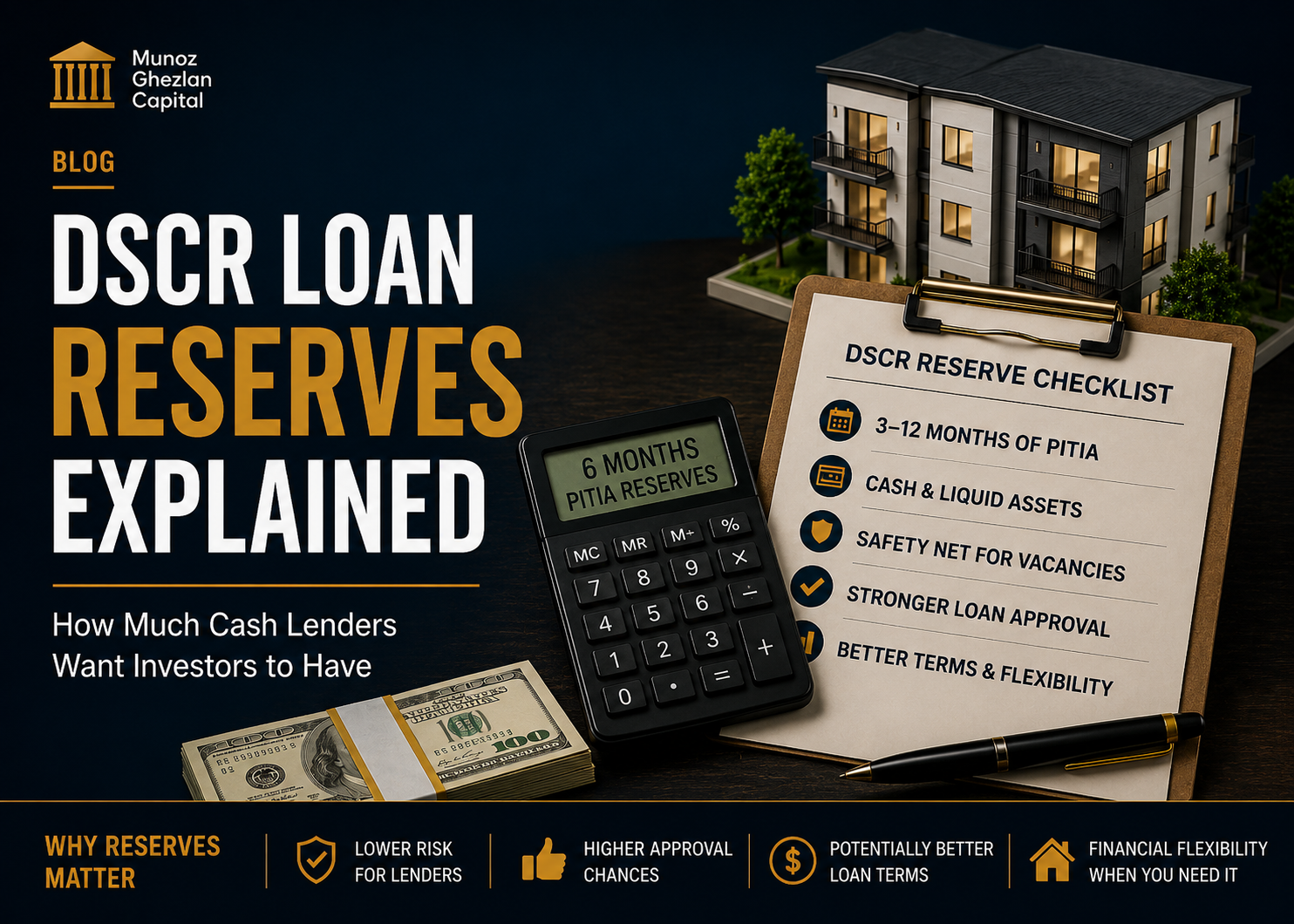
Lenders typically measure reserves in months of PITIA, which includes principal, interest, property taxes, insurance, and HOA dues, if applicable.
For example, if your monthly PITIA payment is $2,500 and the lender requires six months of reserves, you would need to show $15,000 in qualifying assets.
Why Do DSCR Lenders Require Cash Reserves?
Traditional mortgage lenders often verify employment history, tax returns, and personal income. DSCR lenders take a different approach.
Because the loan is primarily based on the property's ability to generate rental income, lenders rely on additional safeguards to reduce risk. One of those safeguards is cash reserves.
Rental properties don't always perform as expected. Vacancies happen. Tenants can stop paying rent. Major repairs can appear without warning. Reserve requirements help ensure that borrowers have enough financial flexibility to handle these situations without falling behind on mortgage payments.
From a lender's perspective, strong reserves often indicate a more prepared and financially stable investor.
How Much Cash Do DSCR Lenders Usually Require?
Most DSCR lenders require between three and twelve months of reserves.
The exact amount depends on the lender's guidelines and the overall risk profile of the loan.
A borrower with excellent credit, a strong DSCR ratio, and substantial experience may qualify with fewer reserves. Meanwhile, investors with higher leverage or weaker borrower profiles may be required to hold significantly more cash.
Here is what investors commonly encounter:
Three months of reserves
Typically reserved for highly qualified borrowers with strong credit scores and lower-risk properties.
Six months of reserves
The most common requirement for standard DSCR loans.
Nine to twelve months of reserves
Often required for higher-risk loans, lower DSCR ratios, cash-out refinances, or borrowers with multiple financed properties.
Reserve Calculation Example
Let's assume your rental property's monthly PITIA payment is $3,000.
- Three months reserves = $9,000
- Six months reserves = $18,000
- Nine months reserves = $27,000
- Twelve months reserves = $36,000
Remember that these funds must generally remain available after accounting for the down payment, closing costs, and other transaction expenses.
Factors That Influence DSCR Reserve Requirements
Not every borrower receives the same reserve requirement. Lenders evaluate several factors before determining how much liquidity they want to see.
Credit Score
Borrowers with stronger credit profiles generally present less risk. As a result, lenders may be more flexible with reserve requirements.
Investors with lower credit scores may need to compensate by maintaining larger reserve balances.
DSCR Ratio
The debt service coverage ratio remains one of the most important components of any DSCR loan application.
A property with a DSCR of 1.30 or 1.40 demonstrates stronger cash flow than a property with a ratio of 1.00.
Higher DSCR ratios often result in more favorable lending terms, including lower reserve requirements.
Loan-to-Value Ratio
Lenders typically become more cautious as leverage increases.
A borrower financing 80% of a property's value presents more risk than someone financing 70%. To offset that risk, lenders may require additional reserves.
Property Type
Some property types carry greater operational risk than others.
Short-term rentals, vacation properties, and non-traditional investment properties may trigger higher reserve requirements than long-term residential rentals.
Number of Financed Properties
Investors with large portfolios may face stricter reserve standards.
Some lenders require reserves for both the subject property and other financed properties within the portfolio.
What Assets Count Toward DSCR Loan Reserves?
Not all assets are treated equally.
Lenders generally prefer liquid assets that can be accessed quickly if financial challenges arise.
Checking and Savings Accounts
Cash held in checking and savings accounts is typically counted at full value and remains the most straightforward form of reserves.
Money Market Accounts
Money market accounts are commonly accepted because they provide easy access to funds while offering modest returns.
Certificates of Deposit
Many lenders allow certificates of deposit to count toward reserve requirements, although documentation may be required.
Brokerage Accounts
Stocks, bonds, mutual funds, and exchange-traded funds are frequently accepted. However, lenders may apply a discount to account for market volatility.
Retirement Accounts
Retirement funds such as 401(k)s and IRAs often qualify as reserves, but lenders usually count only a percentage of the balance due to potential taxes and withdrawal penalties.
Cash Value Life Insurance
Some lenders permit the accessible cash value of life insurance policies to be used as reserve assets.
What Usually Doesn't Count as Reserves?
Investors sometimes assume all assets can be used to satisfy reserve requirements. In reality, lenders often exclude several asset categories.
Common examples include:
- Equity in the subject property
- Unverified cash deposits
- Gift funds
- Restricted accounts
- Physical cash holdings
- Assets without documented ownership
- Certain cryptocurrency holdings
- Business funds without proof of unrestricted access
Since guidelines vary by lender, it's always wise to verify which assets qualify before submitting an application.
Why Seasoned Funds Matter
Even if you have sufficient reserves, lenders may still examine where the money came from.
Many DSCR lenders prefer seasoned funds, meaning the assets have been sitting in an account for a period of time before the loan application.
Large unexplained deposits can trigger additional scrutiny and requests for documentation.
For this reason, investors planning to purchase rental properties should organize reserve funds well in advance rather than moving money around shortly before closing.
Can More Reserves Improve Your Loan Terms?
In many cases, yes.
Strong liquidity can work in your favor throughout the underwriting process.
Investors who maintain substantial cash reserves often put themselves in a stronger position during the underwriting process. Lenders view healthy reserve balances as a sign of financial stability and preparedness, which can lead to better approval odds and increased confidence in the borrower's ability to manage unexpected expenses.
In some cases, strong reserves may also help investors qualify for more competitive loan pricing, higher leverage opportunities, or greater flexibility when other aspects of the application fall slightly outside standard guidelines. While cash reserves alone cannot guarantee loan approval, they can serve as a valuable compensating factor that strengthens an application and reduces perceived lending risk.
Common Mistakes Investors Make With DSCR Reserves
Reserve requirements often create problems because borrowers focus exclusively on the down payment.
One of the most common mistakes is draining available cash to maximize purchasing power.
Other frequent errors include:
- Forgetting to account for reserves after closing costs
- Assuming retirement funds count dollar-for-dollar
- Waiting until the last minute to transfer assets
- Overlooking portfolio-wide reserve requirements
- Failing to document the source of funds
- Assuming all lenders follow identical guidelines
Avoiding these mistakes can make the underwriting process significantly smoother.
How Investors Can Prepare for DSCR Reserve Requirements
Preparation starts long before the loan application.
Investors should calculate reserve requirements early, maintain sufficient liquidity, and keep clear documentation for all qualifying assets.
A practical approach is to target at least six months of PITIA reserves even if the lender's minimum requirement is lower. Doing so provides additional financial protection while strengthening your borrowing profile.
In real estate investing, cash reserves are more than a lender requirement. They are a tool that helps investors navigate vacancies, repairs, market shifts, and unexpected expenses without disrupting long-term investment goals.
Final Thoughts
Understanding DSCR loan reserves is essential for anyone pursuing investment property financing. While most borrowers focus on credit scores and rental income, lenders also want assurance that investors have enough liquidity to weather unexpected challenges.
In most cases, lenders require between three and twelve months of PITIA reserves, with six months being the most common benchmark. The exact amount depends on factors such as credit score, DSCR ratio, leverage, property type, and portfolio size.
If you're unsure how much cash reserves you'll need for your next investment property, speaking with an experienced DSCR lending specialist can save you time, money, and unnecessary setbacks. The team at Munoz Ghezlan Capital can review your scenario, explain your financing options, and help you prepare for a smoother approval process. Schedule a consultation today and get personalized guidance for your next real estate investment.
FAQs
1. How many months of reserves are required for a DSCR loan?
Most lenders require between three and twelve months of PITIA reserves, with six months being the most common requirement.
2. What counts as reserves for a DSCR loan?
Checking accounts, savings accounts, brokerage accounts, retirement accounts, money market accounts, and CDs are commonly accepted.
3. Do I need reserves in addition to my down payment?
Yes. DSCR lenders typically require reserve funds to remain available after paying the down payment and closing costs.
4. Can retirement accounts be used as DSCR reserves?
Yes. Many lenders allow retirement accounts to count toward reserve requirements, although they may apply a discount to the account balance.
5. Can more cash reserves help me get approved for a DSCR loan?
In many cases, yes. Strong reserves can improve approval odds and may help borrowers qualify for better loan terms.