
Insights
How to Stress-Test a Rental Property Before You Buy

How to Stress-Test a Rental Property Before You Buy

Learn how to stress test rental property deals before buying using vacancy, rent drops, expenses, and DSCR analysis to avoid risky investments.

Published On  
June 4, 2026
Written By  
Daniel R. Alvarez
Contents

Discover What we can do for you

Talk to an Expert

Subscribe To Our Newsletter

Discover What we can do for you
Thank you! Your submission has been received!
Oops! Something went wrong while submitting the form.
 
class SampleComponent extends React.Component { 
  // using the experimental public class field syntax below. We can also attach  
  // the contextType to the current class 
  static contextType = ColorContext; 
  render() { 
    return <Button color={this.color} /> 
  } 
} 

Daniel R. Alvarez

Daniel R. Alvarez is a real estate finance strategist specializing in DSCR loans, investor-focused lending, and alternative funding structures. At Munoz Ghezlan & Co., Daniel works closely with data, deal structures, and market trends to help real estate investors scale portfolios without relying on traditional income documentation. His writing focuses on practical financing strategies, underwriting logic, and real-world investment scenarios that sophisticated investors actually use.

Subscribe To Our Newsletter

Discover What we can do for you
Thank you! Your submission has been received!
Oops! Something went wrong while submitting the form.

Buying a rental property can look incredibly profitable on paper. The numbers may show strong cash flow, healthy appreciation potential, and even tax advantages that make the deal seem like a no-brainer. But experienced investors know something most beginners learn the hard way:

A rental property doesn’t fail in the “best-case scenario.” It fails in the stress scenario.

That’s why learning how to properly stress test rental property deals is one of the most important skills in real estate investing. It separates investors who scale portfolios from those who end up stuck with underperforming or cash-draining assets.

A stress test isn’t about being pessimistic. It’s about being realistic in a market where vacancy, repairs, interest rates, and tenant behavior never stay perfectly stable. If your deal only works under ideal conditions, it’s not a deal, it’s a gamble.

In this guide, we’ll break down exactly how professional investors and lenders analyze risk before buying a property, and how you can apply the same framework to avoid costly mistakes.

Why You Must Stress-Test Every Rental Property

At its core, a stress test rental property analysis asks one simple question:

“If things go wrong, does this deal still survive financially?”

Most beginner investors evaluate properties based on projected rent and expected expenses. But those projections assume perfect conditions, 100% occupancy, stable tenants, no major repairs, and consistent financing costs.

Real estate doesn’t work like that.

Vacancies happen unexpectedly. Repairs come early. Insurance increases without warning. Interest rates shift. And sometimes, entire markets cool down faster than expected.

Stress testing forces you to simulate those realities before you ever commit capital.

Instead of asking:

  • “How much will I make?”

You start asking:

  • “How much can I lose before this becomes a problem?”

That shift in thinking is what turns a beginner into a serious investor.

Step 1: Build a Real Baseline (No Seller Assumptions Allowed)

Before you stress test anything, you need a clean and realistic baseline model. This is where most deals are already overestimated.

Start by replacing all seller-provided numbers with verified market data.

Use actual rental comps, not listing projections. Confirm property taxes from official records. Get real insurance quotes instead of estimates. Include maintenance at 1–1.5% of property value annually. Add CapEx reserves for long-term wear and tear. Include property management fees at 8–10%, even if you plan to self-manage. Use the full mortgage payment, including principal, interest, taxes, and insurance.

This step is critical because a stress test is only as accurate as the baseline it’s built on.

If your starting numbers are inflated, your entire analysis becomes unreliable.

Once your baseline is realistic, you can begin stress testing the deal under pressure.

Step 2: Understand the Core Idea of Stress Testing

A proper stress test rental property evaluation is not a single calculation. It is a series of controlled “what-if” scenarios designed to break the deal in different ways.

Think of it like pressure-testing a bridge. You do not just test normal traffic—you simulate extreme weight, weather conditions, and structural strain to see where it fails.

Real estate works the same way.

You are intentionally introducing risk variables such as lower rental income, higher vacancy rates, increased operating expenses, higher interest rates, and unexpected capital expenditures.

The goal is not to predict the future perfectly. The goal is to understand the breaking point of the investment.

If you know where the deal breaks, you know how much risk you are actually taking.

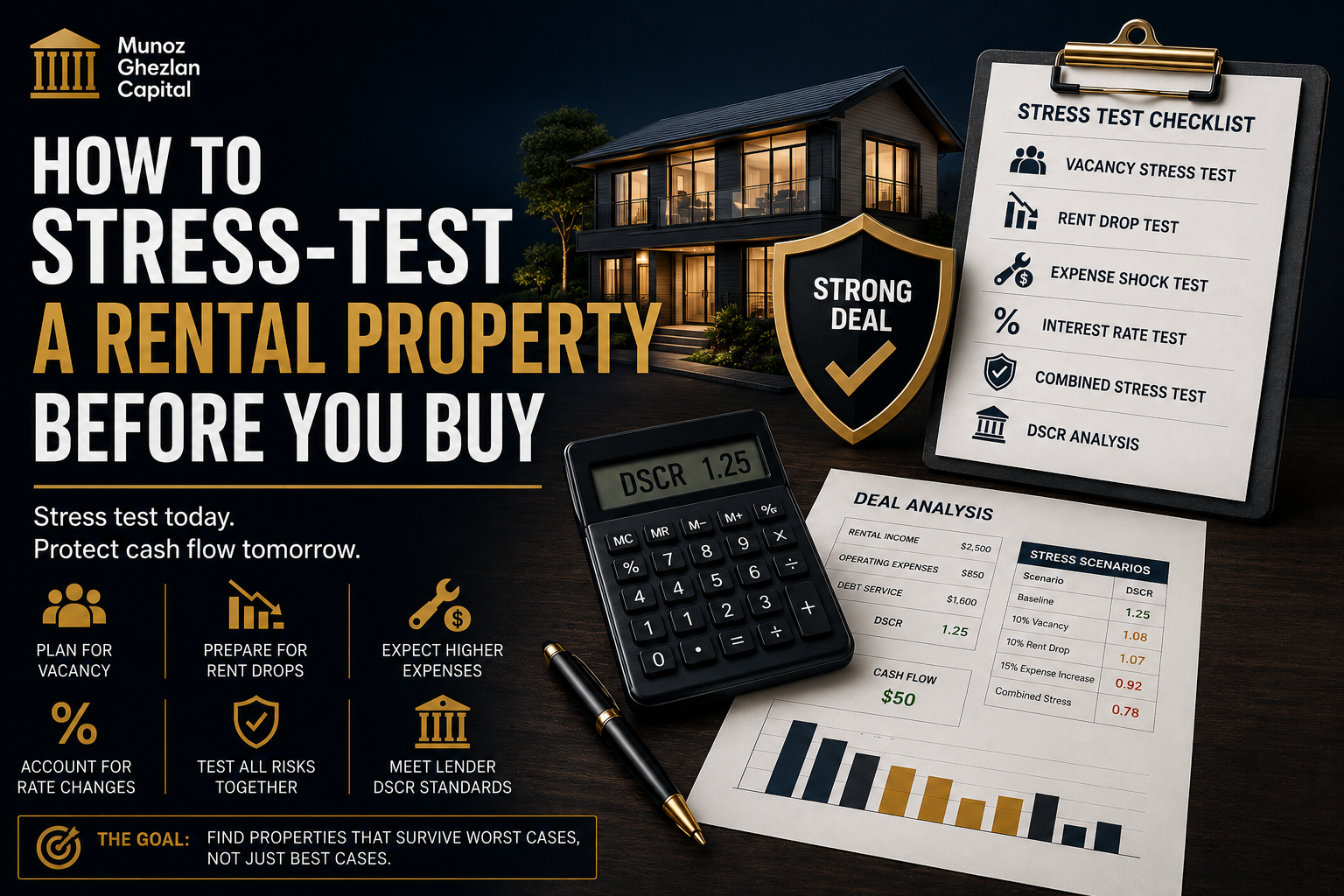
Step 3: The Four Core Stress Scenarios Every Investor Must Run

When you stress test rental property deals professionally, there are four essential risk scenarios you must evaluate. These are the same categories used in institutional underwriting and DSCR-style lending analysis.

Let’s break them down.

1. Vacancy Stress Test

Vacancy is one of the most underestimated risks in rental investing.

Most spreadsheets assume 0–5% vacancy, but real-world properties often experience much more fluctuation, especially during tenant turnover, market slowdowns, or unexpected repairs.

To stress test properly, start with a 5–8% baseline vacancy, then increase it to 10%, 15%, and even 20% in worst-case scenarios.

Now ask yourself whether the property can still cover its mortgage if it sits vacant for 2–3 months, and how quickly cash flow collapses as vacancy increases.

In real investing, vacancies do not arrive smoothly, they come in sudden gaps. A tenant leaving unexpectedly can instantly shift a profitable property into negative cash flow.

2. Rent Drop Stress Test

Rental income is never guaranteed at peak levels forever. Markets shift, demand cools, new supply enters neighborhoods, and tenants negotiate harder.

To simulate this, reduce projected rent by 5%, 10%, and 15%.

Now evaluate the property to determine whether the deal still cash flows and whether it can at least break even under pressure.

This step is especially important in competitive markets where prices are inflated based on recent rental spikes.

Many deals that look strong on paper completely collapse after just a 10% rent reduction.

3. Expense Shock Test

Expenses are one of the most unpredictable parts of real estate investing.

Insurance premiums can rise sharply. Property taxes can be reassessed after purchase. Repairs often appear earlier than expected.

To properly stress test, increase operating expenses by 10–30%.

Now check whether cash flow disappears or whether the property relies too heavily on perfect conditions.

This step reveals whether a deal is structurally safe or overly sensitive to cost fluctuations.

A healthy investment should still function even when expenses rise significantly.

4. Interest Rate Stress Test

Financing risk is often ignored by beginner investors, especially when interest rates are low.

But real investors know rates change, and refinancing can completely reshape a deal.

To test this, increase interest rates by 1–2%, recalculate monthly payments, and evaluate DSCR or cash flow impact.

Ask whether the deal still works if refinancing happens at worse terms or whether it quickly turns negative.

This is especially important for investors using DSCR loans or leverage-heavy strategies.

Step 4: The Combined Stress Test (Where Reality Hits Hard)

Individually, each risk factor tells part of the story. But real life does not isolate problems.

Vacancy, rent drops, expense spikes, and interest rate changes can happen at the same time.

That is why the most important step in a stress test rental property analysis is combining all risks:

  • 10% vacancy
  • 10% rent reduction
  • 15% expense increase
  • 1–1.5% interest rate increase

Now evaluate the deal under these combined conditions.

If the property still cash flows or at least breaks even, it is structurally strong.

If it fails here, it means the deal depends too heavily on ideal conditions, and that is a warning sign most investors ignore until it is too late.

Step 5: DSCR Lender Logic (How Banks Stress-Test Deals)

One of the smartest ways to understand how to stress test rental property deals is to look at how lenders evaluate them, especially DSCR lenders.

Unlike emotional investors, lenders do not care about optimism. They care about whether the property can survive under conservative assumptions.

They may reduce your expected rental income using market adjustments. They assume a vacancy buffer even if the property is fully occupied. They normalize operating expenses based on market averages. They also require a minimum DSCR threshold, often around 1.20 or higher, depending on the lender.

This means that even if your deal looks profitable on paper, it might not pass lender stress testing if it is too tight.

If a bank would not feel comfortable holding this property under stress, you should not either.

A strong investment is not just cash-flow positive, it is lender-resilient under conservative assumptions.

Step 6: Hidden Risks Most Investors Forget

Even after running standard stress scenarios, many investors still miss critical risk factors that quietly destroy returns over time.

Capital expenditures are often ignored or underestimated. These include roof replacement, HVAC systems, plumbing issues, electrical upgrades, and structural repairs. Even if these do not happen immediately, they are inevitable over the holding period.

A proper stress test rental property model always includes long-term reserves, typically 1–1.5% of property value annually. If you ignore CapEx, your “cash flow” is often just delayed expenses.

Many spreadsheets assume vacancy as a small yearly percentage, but reality is different. Vacancy usually hits in chunks. One tenant leaves unexpectedly, the property sits empty for one to three months, and renovation delays extend downtime.

This creates sudden cash flow gaps, not gradual reductions.

Even if you self-manage, your time has value. Most investors eventually hire property managers when scaling portfolios.

A realistic model always includes 8–10% property management fees. Ignoring this inflates returns and leads to poor scaling decisions later.

Many investors only think about buying, not selling. But exit conditions matter just as much.

What if you need to sell in a down market? What if interest rates are high when you exit? What if buyer demand drops?

A strong investment survives not just holding stress, but exit stress too.

Step 7: Final Pass/Fail Framework

After running a full stress analysis, every deal should fall into one of three categories.

A property is strong if it still cash flows after 10% vacancy and a 10% rent drop. It remains stable under increased expenses, DSCR remains healthy under conservative assumptions, and one bad year does not create financial pressure.

These are the types of deals that scale safely.

A property is borderline if it breaks even under stress but does not cash flow strongly. It requires tight expense control to remain profitable, and small changes in assumptions significantly impact performance.

These deals can work, but only with strong reserves and experience.

A property is weak if it only works under ideal conditions. Small changes of 5–10% break cash flow, and it becomes negative under stress scenarios.

These are the most dangerous deals because they look good until reality hits.

Final Thoughts

A successful investor doesn’t just look for profitable properties, they look for resilient ones.

When you stress test rental property deals properly, you stop relying on assumptions and start building a portfolio that can survive real-world conditions: vacancies, rising costs, market shifts, and financing changes.

The goal is not perfection. The goal is durability.

Because in real estate, the best deals aren’t the ones that perform well in ideal conditions, they’re the ones that still work when things don’t go as planned.

If you want help analyzing your next deal, optimizing DSCR financing strategy, or building a scalable rental portfolio model, you can book a strategy session with Munoz Ghezlan & Co.

FAQs

1. What does it mean to stress test a rental property?

Stress testing a rental property means evaluating how the investment performs under worst-case scenarios such as higher vacancy, lower rent, increased expenses, or rising interest rates. It helps investors understand whether a property can still survive financially when conditions are not ideal.

2. Why is stress testing important before buying a rental property?

Stress testing is important because it reveals hidden risks that are not visible in standard cash flow projections. Many properties look profitable on paper but fail when vacancy increases or expenses rise. A proper stress test helps prevent bad investment decisions.

3. What is a good vacancy rate to use in a stress test?

Most investors use 5–8% as a baseline vacancy rate, but stress testing often increases this to 10%, 15%, or even 20%. This helps simulate real-world situations like tenant turnover or market slowdowns.

4. How do lenders use stress testing in DSCR loans?

DSCR lenders apply conservative assumptions by adjusting rental income, adding vacancy buffers, and standardizing expenses. They also require a minimum DSCR ratio (often around 1.20 or higher) to ensure the property can safely cover debt obligations under stress conditions.

5. What is the biggest mistake investors make when stress testing?

The biggest mistake is relying on overly optimistic numbers, such as ignoring CapEx, underestimating vacancy, or excluding property management costs. This leads to inflated returns and deals that fail once real-world conditions hit.

Buying a rental property can look incredibly profitable on paper. The numbers may show strong cash flow, healthy appreciation potential, and even tax advantages that make the deal seem like a no-brainer. But experienced investors know something most beginners learn the hard way:

A rental property doesn’t fail in the “best-case scenario.” It fails in the stress scenario.

That’s why learning how to properly stress test rental property deals is one of the most important skills in real estate investing. It separates investors who scale portfolios from those who end up stuck with underperforming or cash-draining assets.

A stress test isn’t about being pessimistic. It’s about being realistic in a market where vacancy, repairs, interest rates, and tenant behavior never stay perfectly stable. If your deal only works under ideal conditions, it’s not a deal, it’s a gamble.

In this guide, we’ll break down exactly how professional investors and lenders analyze risk before buying a property, and how you can apply the same framework to avoid costly mistakes.

Why You Must Stress-Test Every Rental Property

At its core, a stress test rental property analysis asks one simple question:

“If things go wrong, does this deal still survive financially?”

Most beginner investors evaluate properties based on projected rent and expected expenses. But those projections assume perfect conditions, 100% occupancy, stable tenants, no major repairs, and consistent financing costs.

Real estate doesn’t work like that.

Vacancies happen unexpectedly. Repairs come early. Insurance increases without warning. Interest rates shift. And sometimes, entire markets cool down faster than expected.

Stress testing forces you to simulate those realities before you ever commit capital.

Instead of asking:

  • “How much will I make?”

You start asking:

  • “How much can I lose before this becomes a problem?”

That shift in thinking is what turns a beginner into a serious investor.

Step 1: Build a Real Baseline (No Seller Assumptions Allowed)

Before you stress test anything, you need a clean and realistic baseline model. This is where most deals are already overestimated.

Start by replacing all seller-provided numbers with verified market data.

Use actual rental comps, not listing projections. Confirm property taxes from official records. Get real insurance quotes instead of estimates. Include maintenance at 1–1.5% of property value annually. Add CapEx reserves for long-term wear and tear. Include property management fees at 8–10%, even if you plan to self-manage. Use the full mortgage payment, including principal, interest, taxes, and insurance.

This step is critical because a stress test is only as accurate as the baseline it’s built on.

If your starting numbers are inflated, your entire analysis becomes unreliable.

Once your baseline is realistic, you can begin stress testing the deal under pressure.

Step 2: Understand the Core Idea of Stress Testing

A proper stress test rental property evaluation is not a single calculation. It is a series of controlled “what-if” scenarios designed to break the deal in different ways.

Think of it like pressure-testing a bridge. You do not just test normal traffic—you simulate extreme weight, weather conditions, and structural strain to see where it fails.

Real estate works the same way.

You are intentionally introducing risk variables such as lower rental income, higher vacancy rates, increased operating expenses, higher interest rates, and unexpected capital expenditures.

The goal is not to predict the future perfectly. The goal is to understand the breaking point of the investment.

If you know where the deal breaks, you know how much risk you are actually taking.

Step 3: The Four Core Stress Scenarios Every Investor Must Run

When you stress test rental property deals professionally, there are four essential risk scenarios you must evaluate. These are the same categories used in institutional underwriting and DSCR-style lending analysis.

Let’s break them down.

1. Vacancy Stress Test

Vacancy is one of the most underestimated risks in rental investing.

Most spreadsheets assume 0–5% vacancy, but real-world properties often experience much more fluctuation, especially during tenant turnover, market slowdowns, or unexpected repairs.

To stress test properly, start with a 5–8% baseline vacancy, then increase it to 10%, 15%, and even 20% in worst-case scenarios.

Now ask yourself whether the property can still cover its mortgage if it sits vacant for 2–3 months, and how quickly cash flow collapses as vacancy increases.

In real investing, vacancies do not arrive smoothly, they come in sudden gaps. A tenant leaving unexpectedly can instantly shift a profitable property into negative cash flow.

2. Rent Drop Stress Test

Rental income is never guaranteed at peak levels forever. Markets shift, demand cools, new supply enters neighborhoods, and tenants negotiate harder.

To simulate this, reduce projected rent by 5%, 10%, and 15%.

Now evaluate the property to determine whether the deal still cash flows and whether it can at least break even under pressure.

This step is especially important in competitive markets where prices are inflated based on recent rental spikes.

Many deals that look strong on paper completely collapse after just a 10% rent reduction.

3. Expense Shock Test

Expenses are one of the most unpredictable parts of real estate investing.

Insurance premiums can rise sharply. Property taxes can be reassessed after purchase. Repairs often appear earlier than expected.

To properly stress test, increase operating expenses by 10–30%.

Now check whether cash flow disappears or whether the property relies too heavily on perfect conditions.

This step reveals whether a deal is structurally safe or overly sensitive to cost fluctuations.

A healthy investment should still function even when expenses rise significantly.

4. Interest Rate Stress Test

Financing risk is often ignored by beginner investors, especially when interest rates are low.

But real investors know rates change, and refinancing can completely reshape a deal.

To test this, increase interest rates by 1–2%, recalculate monthly payments, and evaluate DSCR or cash flow impact.

Ask whether the deal still works if refinancing happens at worse terms or whether it quickly turns negative.

This is especially important for investors using DSCR loans or leverage-heavy strategies.

Step 4: The Combined Stress Test (Where Reality Hits Hard)

Individually, each risk factor tells part of the story. But real life does not isolate problems.

Vacancy, rent drops, expense spikes, and interest rate changes can happen at the same time.

That is why the most important step in a stress test rental property analysis is combining all risks:

  • 10% vacancy
  • 10% rent reduction
  • 15% expense increase
  • 1–1.5% interest rate increase

Now evaluate the deal under these combined conditions.

If the property still cash flows or at least breaks even, it is structurally strong.

If it fails here, it means the deal depends too heavily on ideal conditions, and that is a warning sign most investors ignore until it is too late.

Step 5: DSCR Lender Logic (How Banks Stress-Test Deals)

One of the smartest ways to understand how to stress test rental property deals is to look at how lenders evaluate them, especially DSCR lenders.

Unlike emotional investors, lenders do not care about optimism. They care about whether the property can survive under conservative assumptions.

They may reduce your expected rental income using market adjustments. They assume a vacancy buffer even if the property is fully occupied. They normalize operating expenses based on market averages. They also require a minimum DSCR threshold, often around 1.20 or higher, depending on the lender.

This means that even if your deal looks profitable on paper, it might not pass lender stress testing if it is too tight.

If a bank would not feel comfortable holding this property under stress, you should not either.

A strong investment is not just cash-flow positive, it is lender-resilient under conservative assumptions.

Step 6: Hidden Risks Most Investors Forget

Even after running standard stress scenarios, many investors still miss critical risk factors that quietly destroy returns over time.

Capital expenditures are often ignored or underestimated. These include roof replacement, HVAC systems, plumbing issues, electrical upgrades, and structural repairs. Even if these do not happen immediately, they are inevitable over the holding period.

A proper stress test rental property model always includes long-term reserves, typically 1–1.5% of property value annually. If you ignore CapEx, your “cash flow” is often just delayed expenses.

Many spreadsheets assume vacancy as a small yearly percentage, but reality is different. Vacancy usually hits in chunks. One tenant leaves unexpectedly, the property sits empty for one to three months, and renovation delays extend downtime.

This creates sudden cash flow gaps, not gradual reductions.

Even if you self-manage, your time has value. Most investors eventually hire property managers when scaling portfolios.

A realistic model always includes 8–10% property management fees. Ignoring this inflates returns and leads to poor scaling decisions later.

Many investors only think about buying, not selling. But exit conditions matter just as much.

What if you need to sell in a down market? What if interest rates are high when you exit? What if buyer demand drops?

A strong investment survives not just holding stress, but exit stress too.

Step 7: Final Pass/Fail Framework

After running a full stress analysis, every deal should fall into one of three categories.

A property is strong if it still cash flows after 10% vacancy and a 10% rent drop. It remains stable under increased expenses, DSCR remains healthy under conservative assumptions, and one bad year does not create financial pressure.

These are the types of deals that scale safely.

A property is borderline if it breaks even under stress but does not cash flow strongly. It requires tight expense control to remain profitable, and small changes in assumptions significantly impact performance.

These deals can work, but only with strong reserves and experience.

A property is weak if it only works under ideal conditions. Small changes of 5–10% break cash flow, and it becomes negative under stress scenarios.

These are the most dangerous deals because they look good until reality hits.

Final Thoughts

A successful investor doesn’t just look for profitable properties, they look for resilient ones.

When you stress test rental property deals properly, you stop relying on assumptions and start building a portfolio that can survive real-world conditions: vacancies, rising costs, market shifts, and financing changes.

The goal is not perfection. The goal is durability.

Because in real estate, the best deals aren’t the ones that perform well in ideal conditions, they’re the ones that still work when things don’t go as planned.

If you want help analyzing your next deal, optimizing DSCR financing strategy, or building a scalable rental portfolio model, you can book a strategy session with Munoz Ghezlan & Co.

FAQs

1. What does it mean to stress test a rental property?

Stress testing a rental property means evaluating how the investment performs under worst-case scenarios such as higher vacancy, lower rent, increased expenses, or rising interest rates. It helps investors understand whether a property can still survive financially when conditions are not ideal.

2. Why is stress testing important before buying a rental property?

Stress testing is important because it reveals hidden risks that are not visible in standard cash flow projections. Many properties look profitable on paper but fail when vacancy increases or expenses rise. A proper stress test helps prevent bad investment decisions.

3. What is a good vacancy rate to use in a stress test?

Most investors use 5–8% as a baseline vacancy rate, but stress testing often increases this to 10%, 15%, or even 20%. This helps simulate real-world situations like tenant turnover or market slowdowns.

4. How do lenders use stress testing in DSCR loans?

DSCR lenders apply conservative assumptions by adjusting rental income, adding vacancy buffers, and standardizing expenses. They also require a minimum DSCR ratio (often around 1.20 or higher) to ensure the property can safely cover debt obligations under stress conditions.

5. What is the biggest mistake investors make when stress testing?

The biggest mistake is relying on overly optimistic numbers, such as ignoring CapEx, underestimating vacancy, or excluding property management costs. This leads to inflated returns and deals that fail once real-world conditions hit.

INSIGHTS